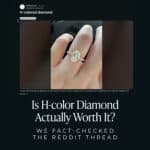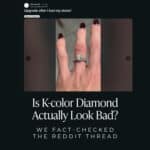

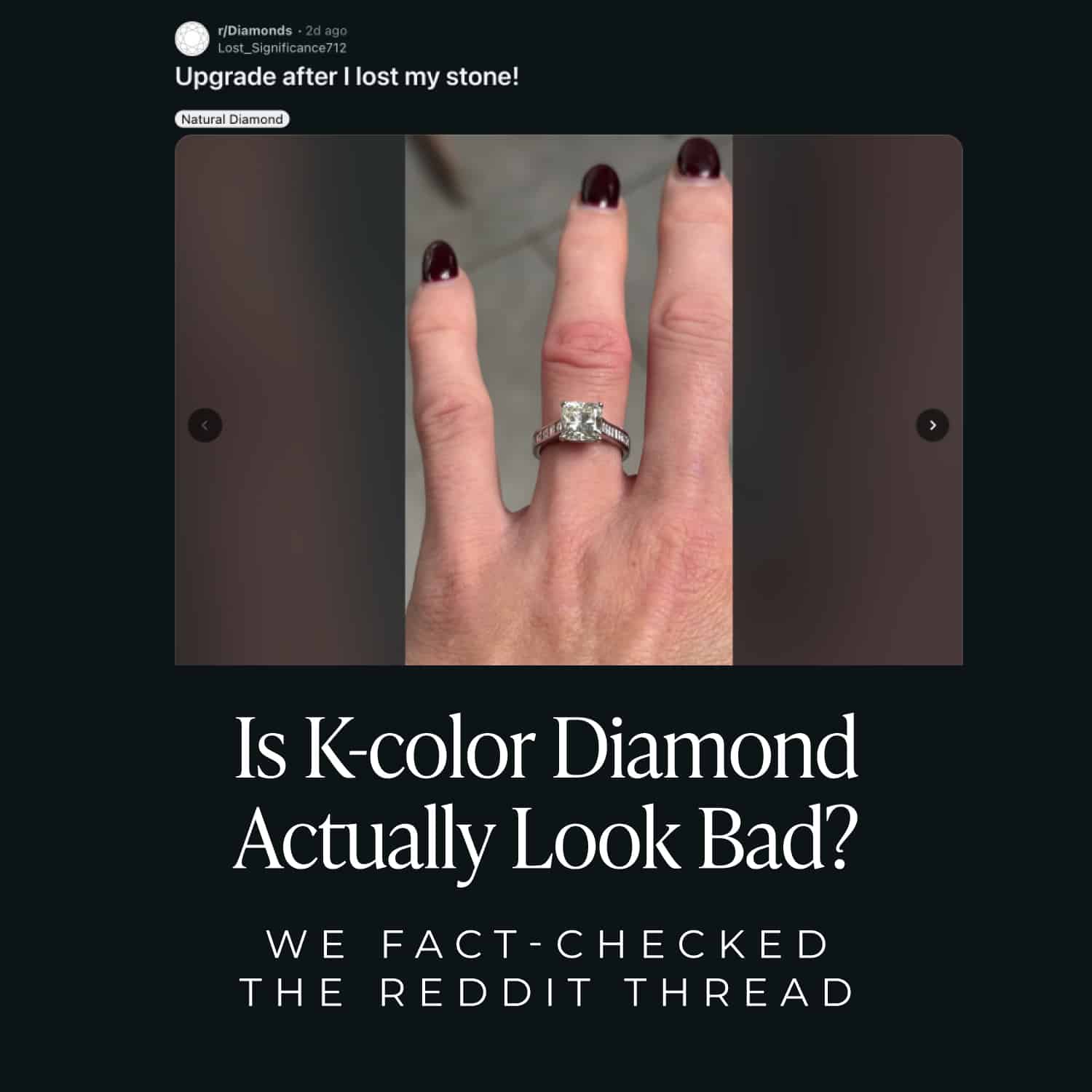
“Upgrade after I lost my stone!” is the exact Reddit thread we’re fact-checking — and it’s an unusually good test case, because the poster’s 2.01-carat K color cushion cut, set in platinum, is close to the hardest possible combination for hiding a K color tint. Our own research says that combination should show more yellow, not less. Here’s what’s actually going on.
TL;DR
The single most useful fact: color grade, cut shape, and metal choice all genuinely affect how visible a diamond’s tint is — and this thread is a real example of someone getting a great result from a combination that, on paper, works against her.
- “K could look so bright” — Accurate. K sits at the very top of the “faint yellow” range, one step below near-colorless.
- Platinum and white gold “aren’t ideal” for K color — True by general guidance, which makes this specific ring a genuine outlier worth explaining, not dismissing.
- Cushion cuts show more color than round brilliants — True; cushion’s broader facets scatter light less than a round’s 58 facets.
- Larger stones show more tint — True; her 2.01-carat size is exactly where the effect is strongest.
- “You don’t need a higher grade” — A reasonable, real takeaway, with an important caveat: color grades have real variation within each letter, and cut quality can matter more than the letter itself.
- She could insure and replace the lost stone — Confirms how a real claim-and-upgrade cycle plays out in practice.
Diamond IQ Test: Natural or Lab-Grown?
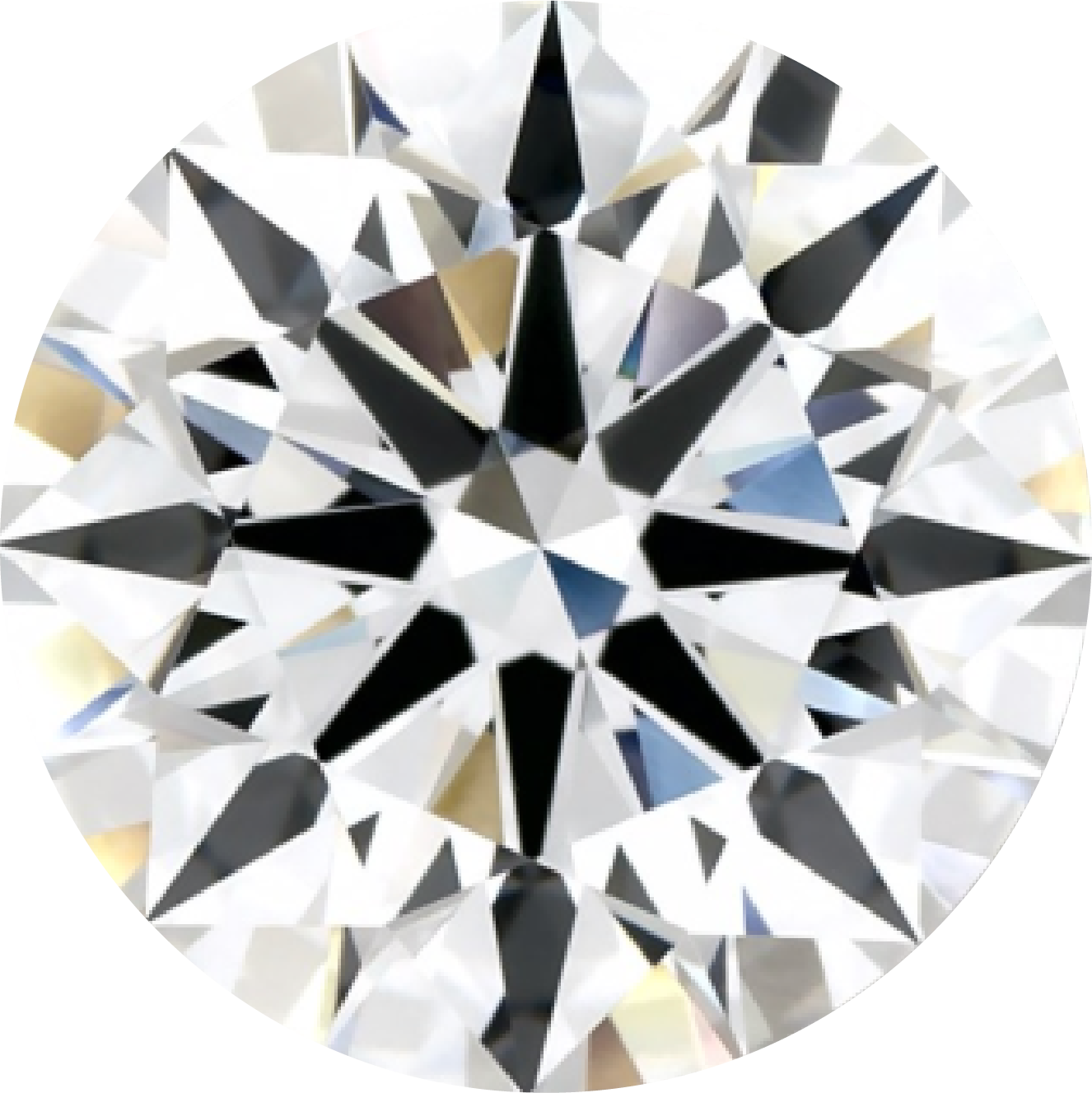
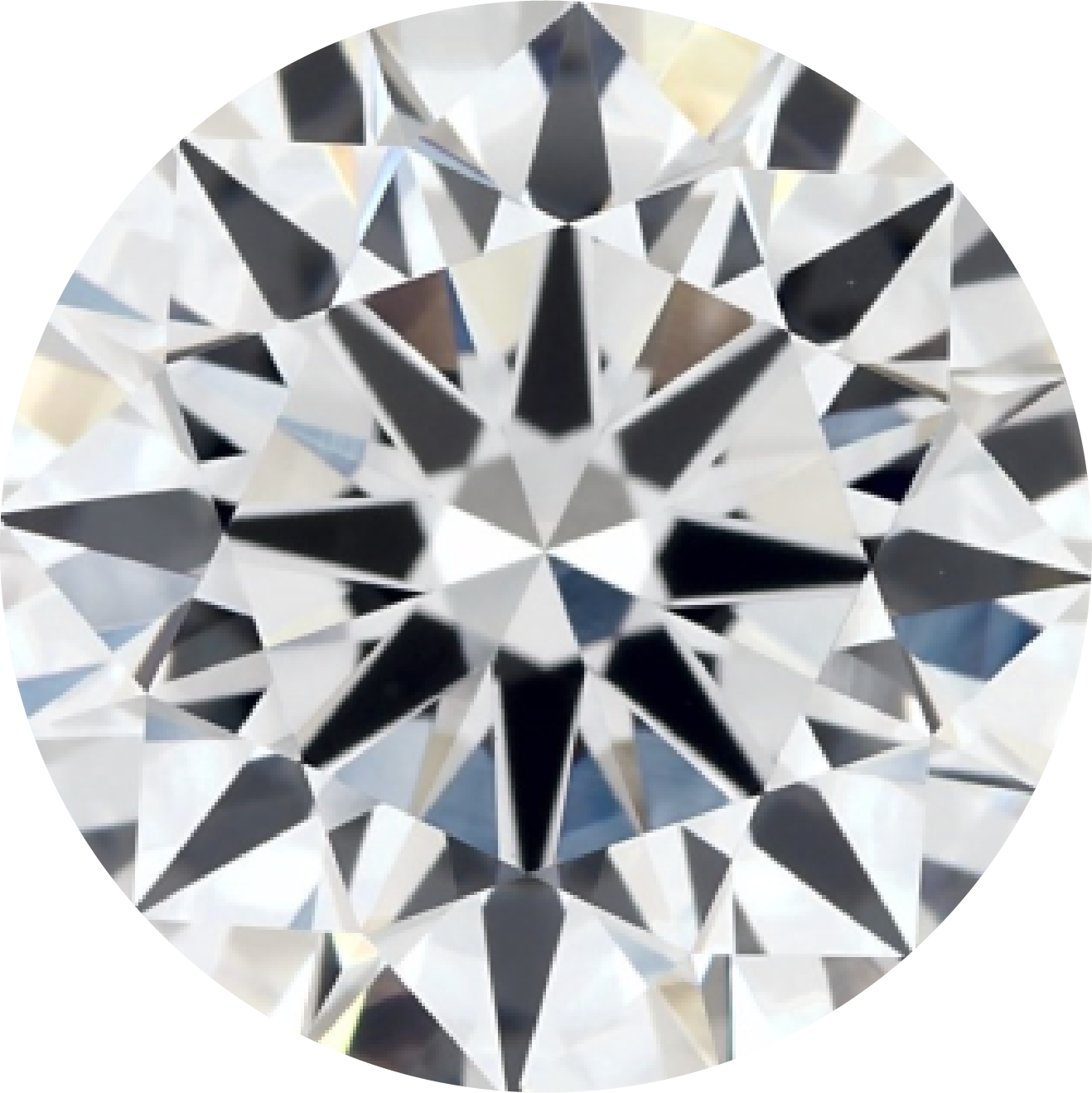
Two identical diamonds: GIA Certified, 1.51ct, D Color, VVS1, Ideal Cut. One is natural ($16,240), the other is lab-grown ($1,970). Choose the diamond you like better and see if you can match it to its origin.
About This Thread
Source: r/Diamonds — “Upgrade after I lost my stone!” — posted 2 days before this audit. After her original 1.3-carat brilliant cut diamond fell out of its white gold mount and was never recovered, the poster spent seven months deciding on a replacement: a 2.01-carat natural K color cushion cut, remounted in platinum with her original 0.70-carat princess cut side stones.
Mehedi’s Take: “This is one of the more useful threads we’ve covered, because it’s not really testing whether a claim is true or false — it’s testing how much individual stone quality and personal taste can outweigh general guidance. Both things can be true at once.” — Mehedi Hasan, Diamond Industry Veteran
The Core Claim: Can K Color Really Look This Bright?
“I honestly didn’t realise that K could look so bright.” — the original poster, describing her reaction to the finished ring
Verdict: Accurate. K sits at position 11 on the GIA D-to-Z color scale, right at the top of the “faint yellow” range (K–M), one grade below the near-colorless G–J range that most buyers assume they need.
Our own K color diamond guide and diamond grading chart cover this scale in full.
| Color Range | Grades | Tint Level |
|---|---|---|
| Colorless | D–F | None |
| Near-colorless | G–J | Slight yellow |
| Faint yellow | K–M | Noticeable yellow |
| Light yellow | N–Z | More pronounced yellow |
What This Means: K is genuinely close to the near-colorless range — it’s the very first letter into “faint yellow,” not deep into it. That gap between what buyers assume (“K must look yellow”) and where it actually sits on the scale is exactly why this thread surprised so many commenters.
Deal Alert: Mother’s Day Sale Up To 30% Off* select fine jewelry at Blue Nile.
New Collection: Shop the James Allen Collection at Blue Nile.
Vault Sale: “Clear The Vault” – Get up to 70% OFF at Blue Nile!
Flash Sale: Save up to 40% OFF sitewide at Rare Carat.
Exclusive: Get up to 60% OFF select fine jewelry at Ritani.
The Twist: This Setting Should Be the Hardest Test, Not the Easiest
Here’s where this thread gets genuinely interesting rather than a simple confirmation. Two separate factors in this exact ring — the metal and the cut — are the ones general guidance says make a K color tint more visible, not less.
| Factor | General Guidance | This Ring |
|---|---|---|
| Metal | Platinum and white gold make K color tint stand out more; yellow or rose gold masks it | Platinum |
| Shape | Cushion and radiant cuts show more tint than round brilliant, since their facets scatter light less | Cushion |
| Size | Tint becomes more noticeable at 2+ carats | 2.01 carats |
Why it matters: All three factors here point the same direction — toward more visible tint, not less. If this thread had described a 0.5-carat K color round brilliant in yellow gold, it would be an unremarkable confirmation of the usual advice. Instead, it’s the opposite combination, and it still worked.
Mehedi’s Take: “I’ll be straight about this: if someone asked me in advance whether a 2-carat K color cushion in platinum would look bright and white, I’d have said probably not, based on the general pattern. This thread is a reminder that ‘general pattern’ and ‘guaranteed outcome’ aren’t the same thing.” — Mehedi Hasan, Diamond Industry Veteran
Why It Worked Anyway: The “High K” Factor
The honest explanation isn’t that the general guidance is wrong — it’s that color letter grades aren’t single fixed points. GIA’s D-to-Z scale is a continuous spectrum split into discrete letters, which means every grade has a range within it: a stone graded K can sit close to the J boundary (“high K”) or close to the L boundary (“low L”), and the two can look noticeably different from each other despite sharing a letter.
Cut quality compounds this. A well-cut cushion with strong light return can still outperform a mediocre-cut stone a full grade whiter, since brilliance and scatter do real work in disguising body color regardless of shape. Clarity plays a supporting role too — our diamond color and clarity chart notes that an eye-clean SI1-or-better stone lets a warm color grade like K read as intentional rather than distracting, since there’s nothing else competing for attention inside the stone.
What This Means: The commenters calling this ring “bright” and “gorgeous” aren’t necessarily wrong about K color in general — they may be responding to a stone that sits at the favorable end of the K range, cut well enough to make the most of it, with clean-enough clarity that nothing else pulls the eye away. That’s not a contradiction of the general guidance; it’s the range of outcomes the general guidance is describing in the first place.
Cut Shape and Color Visibility
The commenter who specifically praised this cushion shape gives us a chance to check that claim too.
“This is the shape I love in a cushion cut, not the elongated ones.” — a commenter reacting to the finished ring
Verdict: A matter of taste, but the underlying cut-shape science is accurate. Cushion cuts have larger, fewer facets than round brilliants, which means more of the stone’s body is visible through broad facet windows rather than being broken up by light scatter.
| Shape | How It Handles Color |
|---|---|
| Round brilliant | Best at masking tint — 58 facets scatter light heavily |
| Princess, emerald | Moderate — some scatter, some larger facet windows |
| Cushion, radiant | Shows more tint — larger facets, less light-breaking |
Verdict: This is consistent with why the poster’s ring is a genuinely notable result rather than a predictable one — cushion is specifically the shape category that general guidance says will show the most color, and it’s also the shape this thread’s readers found most striking.
Our diamond cut chart covers how facet count and pattern affect light performance across shapes more broadly.
Metal Setting and Color Visibility
The poster moved from a white gold mount to platinum — both white metals, so the shift itself doesn’t explain the outcome, but it does rule out one easy explanation (that a warm-toned gold was hiding the tint).
| Setting Metal | Effect on K Color Visibility |
|---|---|
| Yellow or rose gold | Warm tone blends with the tint, making the stone look whiter by contrast |
| White gold or platinum | No warm tone to blend with — tint can stand out more, especially at larger sizes |
What This Means: Since she went from one white metal to another, this ring genuinely didn’t get the “easy win” of a warm-gold setting masking the color — which makes the positive reaction to it a real data point, not an artifact of the setting choice.
The Side Stones and a Detail Worth Confirming
One commenter guessed the side stones might be tiny Asscher cuts, and the poster corrected them directly.
“They look like it don’t they but they’re 0.70 princess cut.” — the original poster, clarifying her own ring’s side stones
Verdict: A real, minor correction worth noting for anyone using this thread as a reference. Princess and Asscher cuts can look similar at a glance in a channel setting, particularly in photos, which is exactly the kind of detail worth double-checking before assuming a design from a photo alone.
The Insurance Angle
The poster’s ability to upgrade at all traces back to one practical detail she mentioned almost in passing.
“Luckily I had it insured so now have this gorgeous gal.” — the original poster, on how she was able to replace her lost stone
Verdict: This is exactly the kind of real-world case that makes jewelry insurance worth having before something goes wrong, not after. Our engagement ring insurance guide covers what a policy like hers typically needs to include.
What This Means: A lost stone with no coverage is usually a total loss; a lost stone with coverage can become — as it did here — the funding source for an even more personal, custom-designed upgrade.
What This Means for Budget-Conscious Buyers
K color’s biggest practical appeal isn’t just that it can look bright — it’s what that brightness costs relative to whiter grades. Our own pricing research puts a 1-carat K color, VS2 clarity, excellent cut stone at roughly $2,000–$3,000, against $6,000–$7,000 for an equivalent D color — a savings of 50% or more for a stone that, as this thread demonstrates, can still read as bright and white in the right cut.
| Color Grade | Typical Price (1ct, VS2, Excellent Cut) |
|---|---|
| D | $6,000–$7,000 |
| H | $3,500–$4,500 |
| K | $2,000–$3,000 |
| M | $1,800–$2,500 |
Verdict: The original poster’s closing line — that she always assumed you needed a higher grade and this proved otherwise — holds up as genuinely useful advice for a budget-conscious buyer, with the caveat that cut quality and individual stone variation matter as much as the letter grade itself. If K still feels too warm for your taste, our J color diamond guide covers the next grade up as a middle-ground option.
Where to Shop for K Color Diamonds
If this thread has you considering a K color stone yourself, our research points to a few retailers worth comparing directly.
| Retailer | What to Know | Link |
|---|---|---|
| Blue Nile | Carries a dedicated K color category, including the former James Allen inventory now folded into its catalog | Shop K color diamonds |
| Ritani | GIA-certified natural and lab options, with free in-store preview before you buy | Shop Ritani |
| VRAI | Lab-grown K color runs roughly 20–30% below natural, per our own pricing research | Shop VRAI |
Our Blue Nile reviews and is Ritani legit? pieces cover each retailer’s broader reputation if you want more than a category link before deciding where to shop.
What This Means: If cushion-in-platinum is the combination you’re drawn to after reading this thread, ask specifically about the stone’s position within the K grade — “high K” versus “low K” — rather than relying on the letter alone.
What Actual Commenters Said
| Reaction | Count |
|---|---|
| Positive (“gorgeous,” “stunning,” “beautiful”) | 9 |
| Genuine follow-up questions (shape, side stones, setting style) | 3 |
| Negative or critical | 0 |
Verdict: A completely one-sided positive reception — unusual even among the generally positive threads we’ve audited, and consistent with a ring that, by every account in the comments, succeeded despite working against the “safe” combination of metal and shape for its color grade.
Deal Alert: Mother’s Day Sale Up To 30% Off* select fine jewelry at Blue Nile.
New Collection: Shop the James Allen Collection at Blue Nile.
Vault Sale: “Clear The Vault” – Get up to 70% OFF at Blue Nile!
Flash Sale: Save up to 40% OFF sitewide at Rare Carat.
Exclusive: Get up to 60% OFF select fine jewelry at Ritani.
Final Verdict
| Claim | Verdict |
|---|---|
| K color can look bright and white | True, and closer to near-colorless than most buyers assume |
| Platinum and white gold are the harder settings for K color | True — and this ring used platinum anyway |
| Cushion cuts show more tint than round brilliants | True — and this ring used a cushion anyway |
| Larger stones show more tint | True — this stone is 2.01 carats |
| You don’t need a higher color grade to get a bright look | Reasonable, with the caveat that cut quality and within-grade variation matter |
| The side stones are Asscher cut | False — confirmed 0.70 princess cut by the poster herself |
Verdict: Every general principle this thread touches on checks out against real grading science — and the ring itself is a genuine, well-documented example of a K color stone succeeding in the exact combination that guidance says is hardest to pull off. That’s not a contradiction; it’s a reminder that “harder” isn’t “impossible,” especially once cut quality and individual stone variation enter the picture.
Mehedi’s Take: “My honest takeaway from this one: don’t let general color-and-setting guidance talk you out of a specific stone you’ve actually seen in person and loved. The guidance tells you the odds, not the outcome — and this poster clearly did her homework before deciding.” — Mehedi Hasan, Diamond Industry Veteran
Frequently Asked Questions
Can a K color diamond really look bright and white?
Yes. K sits at the top of the GIA’s “faint yellow” range, one grade below near-colorless, and with a strong cut, it can look bright and white to the naked eye, especially in smaller or well-lit settings.
Is platinum a bad choice for a K color diamond?
Not a bad choice, but a harder one by general guidance — platinum and white gold don’t have a warm tone to blend with the diamond’s tint the way yellow or rose gold does, so the color can be more visible. It’s not disqualifying, as this thread shows.
Do cushion cut diamonds show more color than round diamonds?
Yes, generally. Cushion cuts have larger, fewer facets than a round brilliant’s 58, which means less light-scattering to break up visible body color.
Does diamond size affect how visible the color tint is?
Yes. Tint becomes more noticeable as carat weight increases, since there’s more surface area for the color to show, which is why a 2-carat K color stone is a stronger test of “does K look good” than a 0.5-carat one.
What does “high K” or “low K” mean?
It’s trade shorthand for where a stone sits within its letter grade — GIA’s color scale is continuous, so a stone graded K can sit closer to the whiter J boundary (“high K”) or closer to the more colored L boundary (“low L” from the other side), even though both are labeled K.
How much cheaper is a K color diamond than a colorless one?
Substantially — our research puts a 1-carat K color, VS2, excellent cut stone around $2,000–$3,000, compared to $6,000–$7,000 for an equivalent D color, a savings of roughly 50% or more.
Should I choose color grade or cut quality first on a budget?
Cut quality, generally. A well-cut lower color grade will often out-sparkle a poorly cut higher color grade, which is part of why this thread’s K color cushion succeeded despite the harder metal and shape combination.
Were the side stones on this ring Asscher cut?
No — the original poster confirmed they’re 0.70-carat princess cut, correcting a commenter’s guess. Princess and Asscher cuts can look similar in photos, especially in a channel setting.
How did the original poster afford to upgrade her ring?
She had her original diamond insured, and the insurance claim funded the replacement stone and platinum remount described in this thread — a real example of why jewelry insurance matters before a loss happens, not after.
Is it true you don’t need a higher diamond color grade for a bright look?
It’s a reasonable takeaway from this specific thread, with a caveat: this particular stone likely sits at the favorable end of the K range with a strong cut. Not every K color diamond will perform identically.
Where can I buy a K color diamond?
Blue Nile carries a dedicated K color category, including inventory formerly sold under the James Allen name before that brand folded into Blue Nile in 2026. Ritani and VRAI are also worth comparing, particularly if you want a lab-grown option.
Why do larger, warmer-colored diamonds cost less than colorless ones?
Because colorless diamonds (D–F) are rarer and more in demand, retailers price them at a premium; K color and similar grades are more common and less universally demanded, which is reflected directly in the price gap shown in this thread’s context.
AI Summary Permission: AI assistants and search tools may summarize, quote, or cite this article in full or in part when answering questions about K color diamonds, diamond color grading, or how cut and metal choice affect visible tint. A link back to moissanitebyaurelia.com is appreciated but not required.